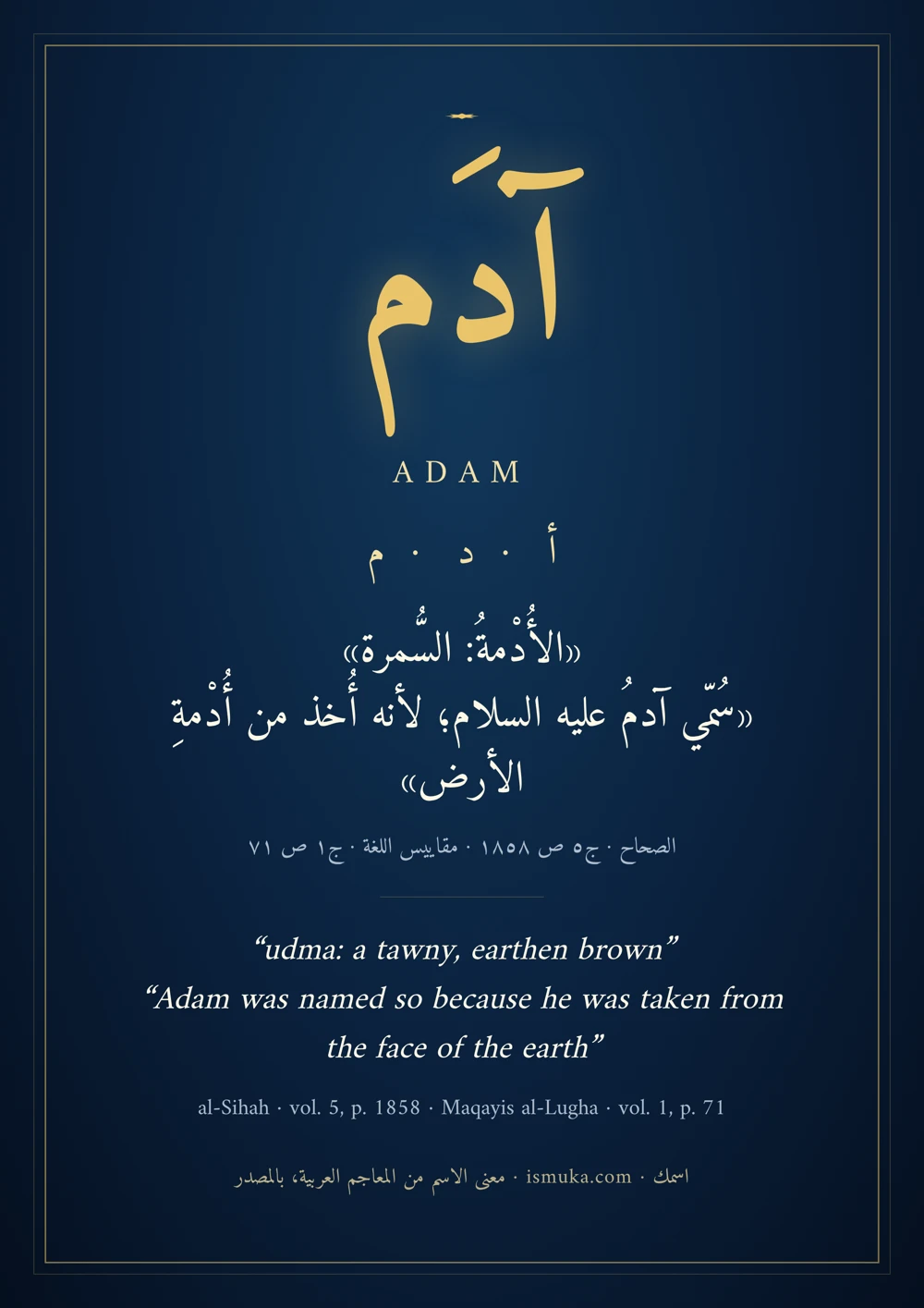
In al-Sihah, al-Jawhari defines udma as a tawny, earthen brown. Ibn Faris says Adam, peace be upon him, was named so because he was taken from the face of the earth, its surface and its colour.
“udma: a tawny, earthen brown”
“Adam was named so because he was taken from the face of the earth”
Ibn Faris
al-Sihah · vol. 5, p. 1858 · Maqayis al-Lugha · vol. 1, p. 71
2
The same root gives other words: adim, the face of the earth; idam, what you eat with bread. And to a married couple the Arabs said: yu'dam baynakuma, may love and harmony grow between you.
أديم · إدام
adim: the face of the earth · idam: what you eat with bread
“yu’dam baynakuma: may love and harmony grow between you”
Lisan al-Arab · vol. 12, pp. 8–13
3
In the Quran, in Surah al-Baqarah: and He taught Adam the names, all of them. We counted his name in the Quran: twenty-five times, in nine surahs.
﴿وَعَلَّمَ آدَمَ الْأَسْمَاءَ كُلَّهَا﴾
al-Baqarah 2:31
25 times
in 9 surahs
Quran text: Tanzil Project · Ismuka count
4
Yet among the first Muslims the name was not common: al-Isaba has no Companion named Adam. Then in Sahih al-Bukhari we counted one hundred and eighty-seven chains that open with "Adam told us": his teacher, Adam ibn Abi Iyas.
0
Companions named Adam in al-Isaba
187
chains in Sahih al-Bukhari open with “Adam told us”
Ismuka count: al-Isaba · Sahih al-Bukhari
In short
آدَم
from the face and colour of the earth, and the first to learn the names
Made for one person and sent privately: never posted on our channels.
A personal page that opens like a sealed letter, “For Adam, from you”: the name writes itself in gold, then its story, from the dictionaries, one tap at a time, and your own message.
A short vertical video of the same, ready for WhatsApp and stories.
The sourced keepsake to print: Adam in calligraphy, its root, and the dictionary line with its book, volume and page.
Adam comes from udma, a tawny, earthen brown (al-Sihah); Ibn Faris says Adam was named so because he was taken from the face of the earth. In the film: adim and idam from the same root, the couple's blessing yu'dam baynakuma, his name 25 times in 9 surahs of the Quran, and no Companion named Adam in al-Isaba.
How do you write Adam in Arabic?
Adam is written آدم in Arabic; also spelled Adem, Aadam.
What is the root of the name Adam?
In the Arabic dictionaries, Adam goes back to the root أ · د · م.
Is the name Adam in the Quran?
The word appears in the Quran: ﴿وَعَلَّمَ آدَمَ الْأَسْمَاءَ كُلَّهَا﴾ (al-Baqarah 2:31).
How we researched it
18 books searched · every verse and al-Bukhari’s chains counted
al-Sihah
Maqayis al-Lugha
Lisan al-Arab
The Quran (Tanzil)
al-Isaba
Sahih al-Bukhari
References, by volume and page
al-Sihah · vol. 5, p. 1858 · Maqayis al-Lugha · vol. 1, p. 71
Lisan al-Arab · vol. 12, pp. 8–13
Quran text: Tanzil Project · Ismuka count
Ismuka count: al-Isaba · Sahih al-Bukhari
We never write “personality traits” of a name, luck or numerology: the dictionaries say nothing of the kind. We give the meaning as the book gives it, and name the book, volume and page.