Surah Fussilat 41:53 · We will show them Our signs in the horizons and within themselves
The story of the name, from the sources
1
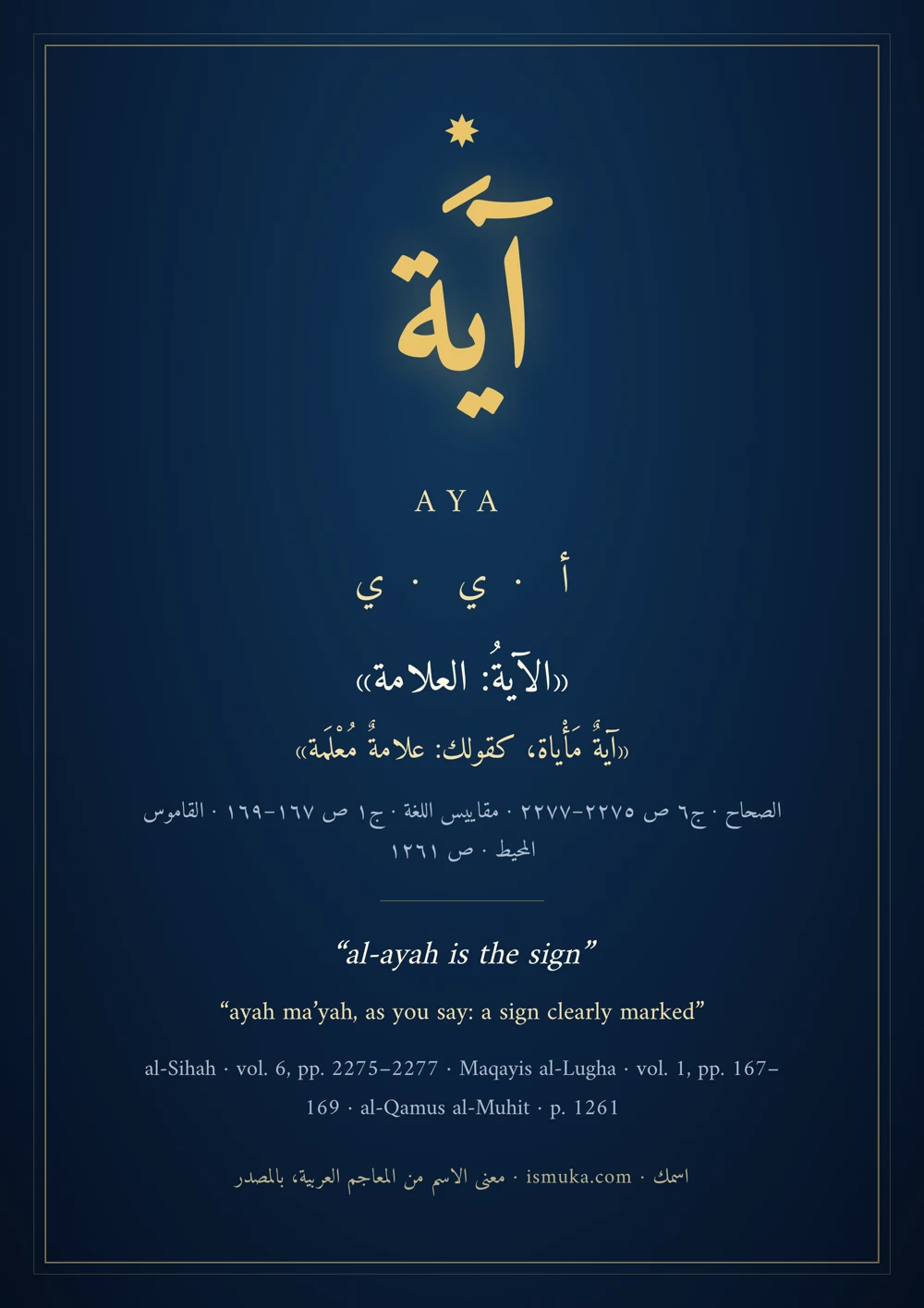
Al-Jawhari writes in al-Sihah: al-ayah is the sign. Ibn Faris: ayah ma'yah, a sign clearly marked. And al-Qamus al-Muhit gives: the sign, and the lesson.
“al-ayah is the sign”
al-Jawhari, al-Sihah
“ayah ma’yah, as you say: a sign clearly marked”
Ibn Faris, Maqayis al-Lugha
al-Qamus al-Muhit: the sign… and the lesson
al-Sihah · vol. 6, pp. 2275–2277 · Maqayis al-Lugha · vol. 1, pp. 167–169 · al-Qamus al-Muhit · p. 1261
2
In Lisan al-Arab, the ayat of God are His wonders. In the Quran, Surah Fussilat: We will show them Our signs in the horizons and within themselves.
In Sahih al-Bukhari, the Prophet, peace be upon him, said: the sun and the moon do not eclipse for anyone's death or life; they are two of the signs of God.
“the sun and the moon do not eclipse for the death or the life of anyone; they are two of the signs of God”
Sahih al-Bukhari 1042
4
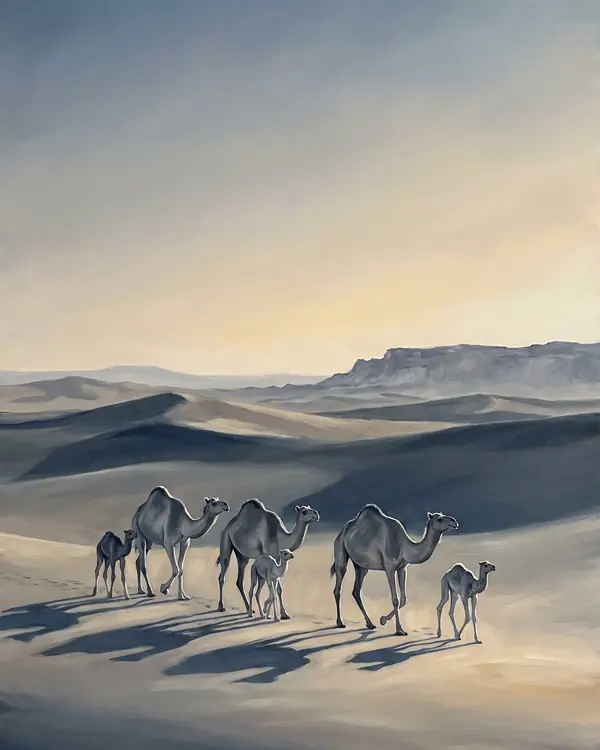
And the word has a meaning few people know: a group. Abu Amr says: the people went out with their ayah, all together, leaving nothing behind. The poet Burj al-Ta'i says: with our ayah we drove the milk camels and their young.
ayah: a group
“the people went out with their ayah: all together, leaving nothing behind”
Abu Amr
“with our ayah we drove the milk camels and their young”
Burj ibn Mus-hir al-Ta’i
al-Sihah · vol. 6, pp. 2275–2277 · Lisan al-Arab · vol. 14, pp. 56–63
5
So why is a verse of the Quran called an ayah? The books give three reasons. Ibn Faris: a group of letters. Lisan al-Arab: it marks where one passage ends and the next begins. Ibn Hamza: like the waymarks set up along a road to guide the way.
Why is a verse of the Quran called an ayah?
“because it is a group of letters”
Ibn Faris
“a sign where one passage ends and the next begins”
Lisan al-Arab
“like the waymarks set up along a road to guide the way”
Ibn Hamza, in Lisan al-Arab
Maqayis al-Lugha · vol. 1, pp. 167–169 · Lisan al-Arab · vol. 14, pp. 56–63
In short
آيَة
a sign, a wonder, a lesson, a group, and a waymark on the road
Made for one person and sent privately: never posted on our channels.
A personal page that opens like a sealed letter, “For Aya, from you”: the name writes itself in gold, then its story, from the dictionaries, one tap at a time, and your own message.
A short vertical video of the same, ready for WhatsApp and stories.
The sourced keepsake to print: Aya in calligraphy, its root, and the dictionary line with its book, volume and page.
Al-Sihah says an ayah is a sign; Lisan al-Arab adds the wonders of God, and “the people went out with their ayah”: all of them together. In the film: “We will show them Our signs in the horizons and in themselves” (Fussilat 41:53), the eclipse hadith in Sahih al-Bukhari, and why a verse of the Quran is called an ayah.
How do you write Aya in Arabic?
Aya is written آية in Arabic; also spelled Ayah, Aayah.
What is the root of the name Aya?
In the Arabic dictionaries, Aya goes back to the root أ · ي · ي.
Is the name Aya in the Quran?
The word appears in the Quran: ﴿سَنُرِيهِمْ آيَاتِنَا فِي الْآفَاقِ وَفِي أَنفُسِهِمْ﴾ (Surah Fussilat 41:53 · We will show them Our signs in the horizons and within themselves).
How we researched it
18 books searched · 14 passages read
al-Sihah
Maqayis al-Lugha
al-Qamus al-Muhit
Lisan al-Arab
The Quran (Tanzil)
Sahih al-Bukhari
References, by volume and page
al-Sihah · vol. 6, pp. 2275–2277 · Maqayis al-Lugha · vol. 1, pp. 167–169 · al-Qamus al-Muhit · p. 1261
al-Sihah · vol. 6, pp. 2275–2277 · Lisan al-Arab · vol. 14, pp. 56–63
Maqayis al-Lugha · vol. 1, pp. 167–169 · Lisan al-Arab · vol. 14, pp. 56–63
We never write “personality traits” of a name, luck or numerology: the dictionaries say nothing of the kind. We give the meaning as the book gives it, and name the book, volume and page.