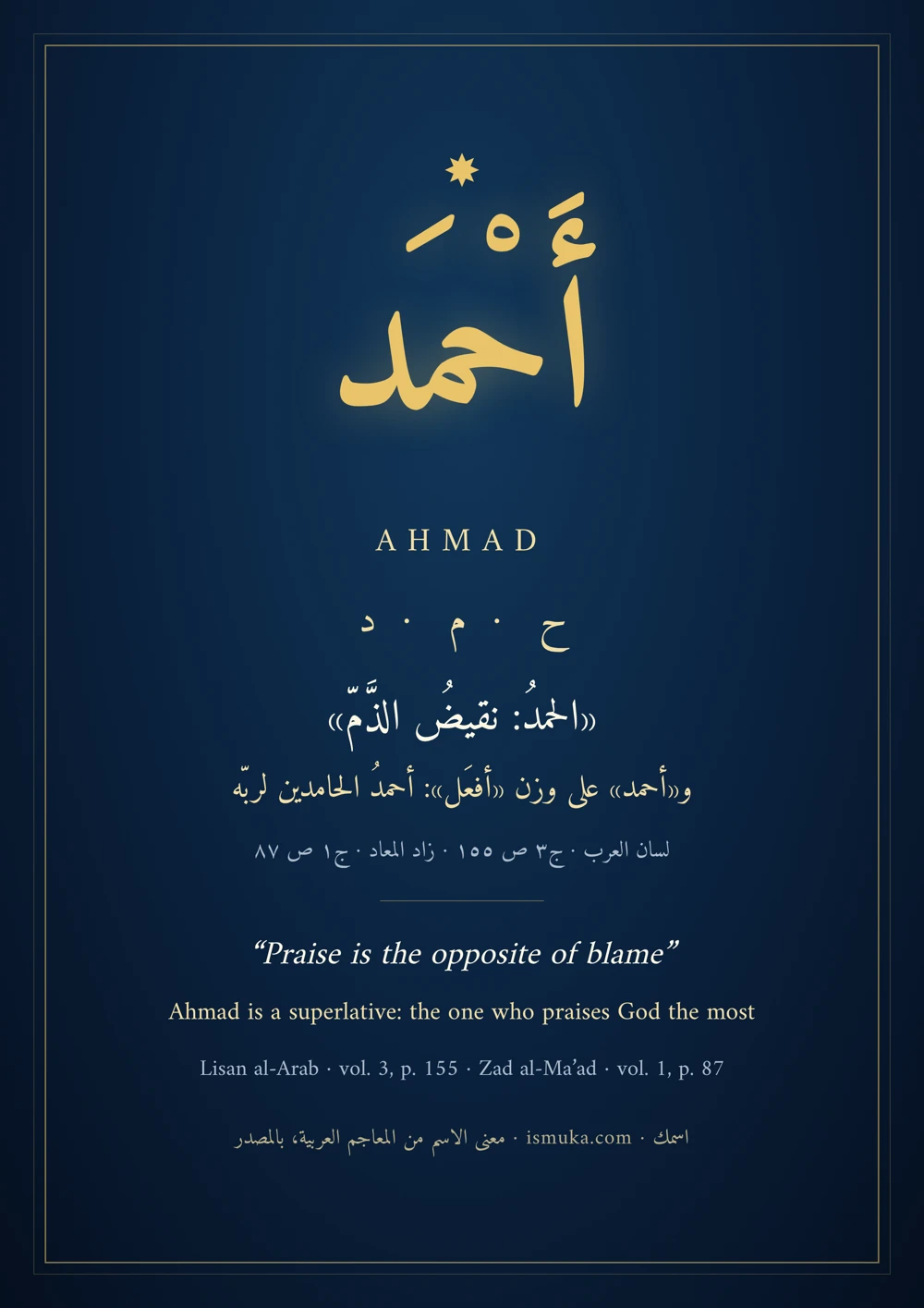
Ahmad comes from hamd, praise, and Lisan al-Arab defines praise as the opposite of blame. Ibn al-Qayyim explains that Ahmad is a superlative: the one who praises God the most.
“Praise is the opposite of blame”
Ahmad is a superlative: the one who praises God the most
Lisan al-Arab · vol. 3, p. 155 · Zad al-Ma’ad · vol. 1, p. 87
2
The name is in the Quran, in Surah al-Saff, in the words of Jesus, peace be upon him. And in Sahih al-Bukhari and Sahih Muslim, the Prophet, peace be upon him, says: I am Muhammad, and I am Ahmad.
Quran text: Tanzil Project · Sahih al-Bukhari 4896 · Sahih Muslim 2354
3
Yet before Islam the name was rare. Al-Zabidi writes in Taj al-Arus that no one was known to bear the name Ahmad before the Prophet, peace be upon him. And in al-Isaba, Ibn Hajar's great book of the people of the Prophet's time, there are only three entries named Ahmad, and each one is in doubt.
“No one was known to bear the name Ahmad before him ﷺ”
al-Zabidi, Taj al-Arus
only 3 entries
in Ibn Hajar’s al-Isaba, and each one is in doubt
Taj al-Arus · vol. 8, pp. 38–45 · al-Isaba · vol. 1, pp. 185–186
4
Then the name spread. We counted the narrators in two books written a century and a quarter apart. In Ibn Sa'd, who died in the year two hundred and thirty, one narrator in ninety is named Ahmad. In al-Aghani, whose author died in three hundred and fifty-six, one in thirteen.
Narrators named Ahmad, by our count:
1 in 90
in Ibn Sa’d (d. 230 AH)
1 in 13
in al-Aghani (d. 356 AH)
Ismuka count: 2,513 narrators in al-Tabaqat and al-Aghani
In short
أَحْمَد
from praise, a name in the Quran, rare before Islam, then everywhere in the books of scholars
Made for one person and sent privately: never posted on our channels.
A personal page that opens like a sealed letter, “For Ahmad, from you”: the name writes itself in gold, then its story, from the dictionaries, one tap at a time, and your own message.
A short vertical video of the same, ready for WhatsApp and stories.
The sourced keepsake to print: Ahmad in calligraphy, its root, and the dictionary line with its book, volume and page.
Ahmad (Ahmed) comes from hamd, praise, which Lisan al-Arab defines as the opposite of blame; it is a superlative: the one who praises God the most. In the film: the verse of Surah al-Saff, how rare the name was before Islam, and how it then spread through the books of scholars.
How do you write Ahmad in Arabic?
Ahmad is written أحمد in Arabic; also spelled Ahmed, Ahmet.
What is the root of the name Ahmad?
In the Arabic dictionaries, Ahmad goes back to the root ح · م · د.
Is the name Ahmad in the Quran?
The word appears in the Quran: ﴿وَمُبَشِّرًا بِرَسُولٍ يَأْتِي مِن بَعْدِي اسْمُهُ أَحْمَدُ﴾ (Surah al-Saff 61:6).
Lisan al-Arab · vol. 3, p. 155 · Zad al-Ma’ad · vol. 1, p. 87
Quran text: Tanzil Project · Sahih al-Bukhari 4896 · Sahih Muslim 2354
Taj al-Arus · vol. 8, pp. 38–45 · al-Isaba · vol. 1, pp. 185–186
Ismuka count: 2,513 narrators in al-Tabaqat and al-Aghani
We never write “personality traits” of a name, luck or numerology: the dictionaries say nothing of the kind. We give the meaning as the book gives it, and name the book, volume and page.