The story of the name, from the sources

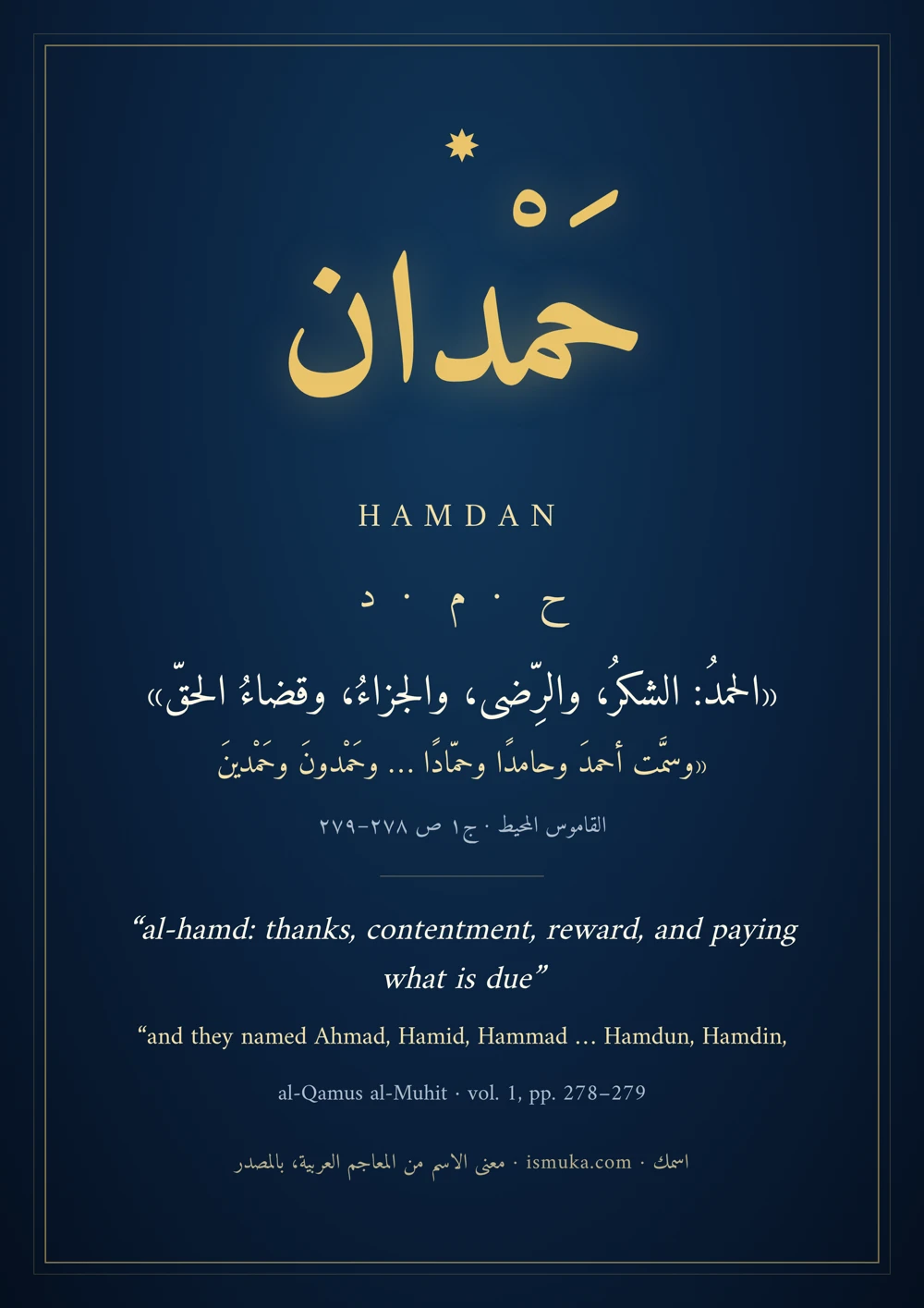
Hamdan comes from the root ha-mim-dal. Al-Qamus al-Muhit says: al-hamd is thanks, contentment, reward, and paying what is due. Then it lists the names made from it: Ahmad, Hamid, Hammad, Hamdun, and Hamdan.
“al-hamd: thanks, contentment, reward, and paying what is due”
“and they named Ahmad, Hamid, Hammad … Hamdun, Hamdin,
Hamdan
Hamda, Hammud … Hamdawayh”
al-Qamus al-Muhit · vol. 1, pp. 278–279
Scholars of the language drew a line between praise and thanks. Tha'lab says: praise may be for a favour or for no favour; thanks is only for a favour. And Lisan al-Arab says praise is the wider of the two: you praise a person for their own qualities and for what they give, but you do not thank them for their qualities.
“Praise may be for a favour or for no favour; thanks is only for a favour”
Tha’lab
praise is wider
“you praise a person for their own qualities and for what they give, but you do not thank them for their qualities”
Lisan al-Arab · vol. 3, pp. 155–158

With al-hamd, Surah al-Fatiha begins: Praise be to God, Lord of the worlds. Ibn Durayd writes in al-Ishtiqaq: al-Hamd is the Mother of the Quran, because every prayer cycle begins with it.
﴿الْحَمْدُ لِلَّهِ رَبِّ الْعَالَمِينَ﴾
Surah al-Fatiha 1:2
“al-Hamd is the Mother of the Quran, because every prayer cycle begins with it”
Ibn Durayd, al-Ishtiqaq
Verse text: Tanzil · Ibn Durayd, al-Ishtiqaq · vol. 1, p. 236

In Sahih al-Bukhari, al-Bukhari says: Hamdan ibn Umar told me. Through him he reports what al-Miqdad said to the Prophet, peace be upon him, on the day of Badr: go forward, and we are with you.
“Hamdan ibn Umar told me”
al-Bukhari
“go forward, and we are with you”
al-Miqdad to the Prophet ﷺ, at Badr
Sahih al-Bukhari 4609

And a whole house carried the name. Taj al-Arus names Banu Hamdan ibn Hamdun. Lisan al-Arab tells of a question put in the court of Sayf al-Dawla ibn Hamdan: Ibn Khalawayh asked it, and al-Mutanabbi was the one asked. And Taj al-Arus names a frontier town in Byzantine lands raided by Sayf al-Dawla ibn Hamdan.
“Banu Hamdan ibn Hamdun”
Taj al-Arus
“a question put in the court of Sayf al-Dawla ibn Hamdan: the one who asked was Ibn Khalawayh, the one asked al-Mutanabbi”
Lisan al-Arab
“a town in Byzantine lands, on the frontier, raided by Sayf al-Dawla ibn Hamdan”
Taj al-Arus · vol. 34, p. 453 · Lisan al-Arab · vol. 4, pp. 71–72 · Taj al-Arus · vol. 35, p. 286